
Online Collection
« Prev - 1 of 1 results - Next »
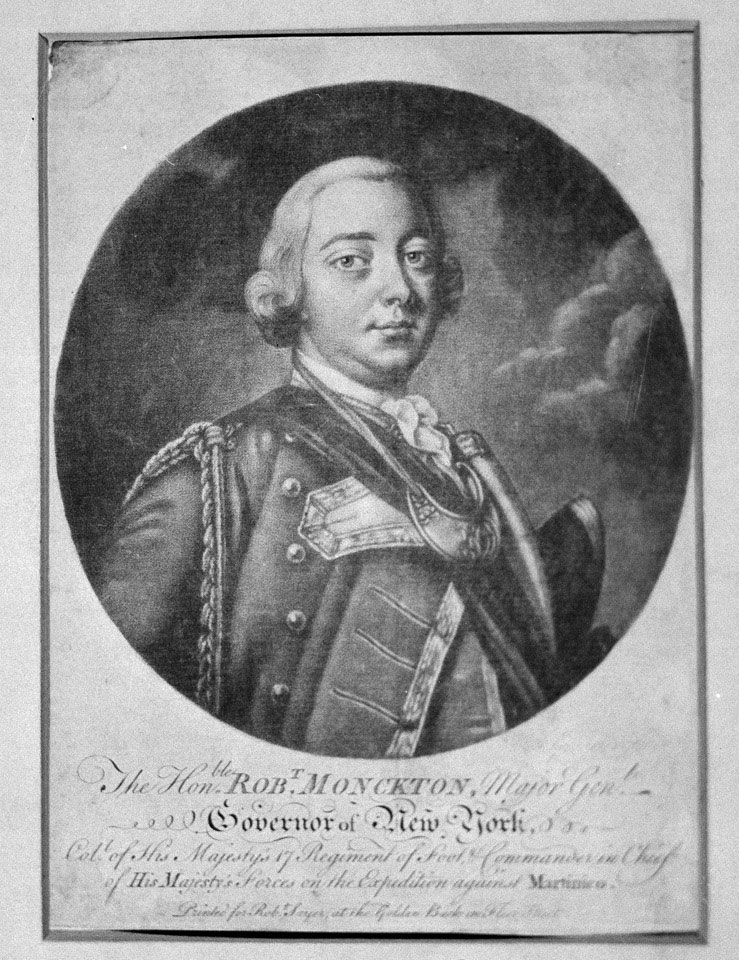
Major General Robert Monckton, 1762 (c)
Mezzotint engraving by J McArdell after Thomas Hudson, 1762 (c).
Monckton's military career was largely centred in North America, most significantly as General Wolfe's second-in-command at Quebec in 1759. The text on this print refers to his stint as Governor of New York (1761-1763) and his role in the capture of Martinique. There had previously been several unsuccessful British attempts to take this important sugar island. In 1762 it was heavily garrisoned with over 12,000 French soldiers, local militia and hired 'privateersmen'. Monckton assembled his force in Barbados, amounting to about 8,000 troops in total, including 5,000 British redcoats from America, and local volunteers from the British-held islands of the West Indies (Barbados, Antigua, Montserrat, St Christopher and Nevis).
They landed in Martinique on 16 January 1762 and began the arduous task of hauling the artillery across various gullies and ravines, but found the way blocked by a number of redoubts held by local militiamen. Monckton was forced to set up batteries to take these and his force fought all the way - at a cost of nearly 400 killed and wounded, to where the French had retreated, Fort Royal and Morne Grenier, an adjacent hill. On 27 January the French made a daring attack which failed, while the British gave chase up Morne Grenier and took the position.
Fort Royal surrendered a few days later and within nine days the whole island had capitulated. Monckton immediately sent detachments off to take the neighbouring islands of St Lucia, Grenada and St Vincent, bringing all of the Leeward and Windward Islands under British control. They remain part of the British Commonwealth today.
NAM Accession Number
NAM. 1968-06-77-1
Copyright/Ownership
National Army Museum, Out of Copyright
Location
National Army Museum, Study collection
Object URL
https://collection.nam.ac.uk/detail.php?acc=1968-06-77-1