
Online Collection
« Prev - 1 of 1 results - Next »
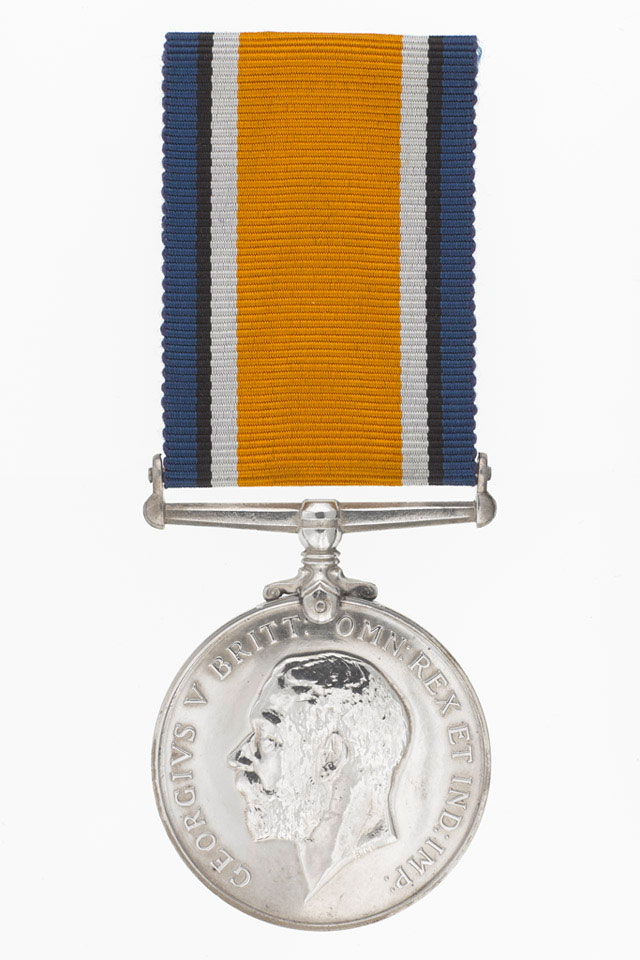
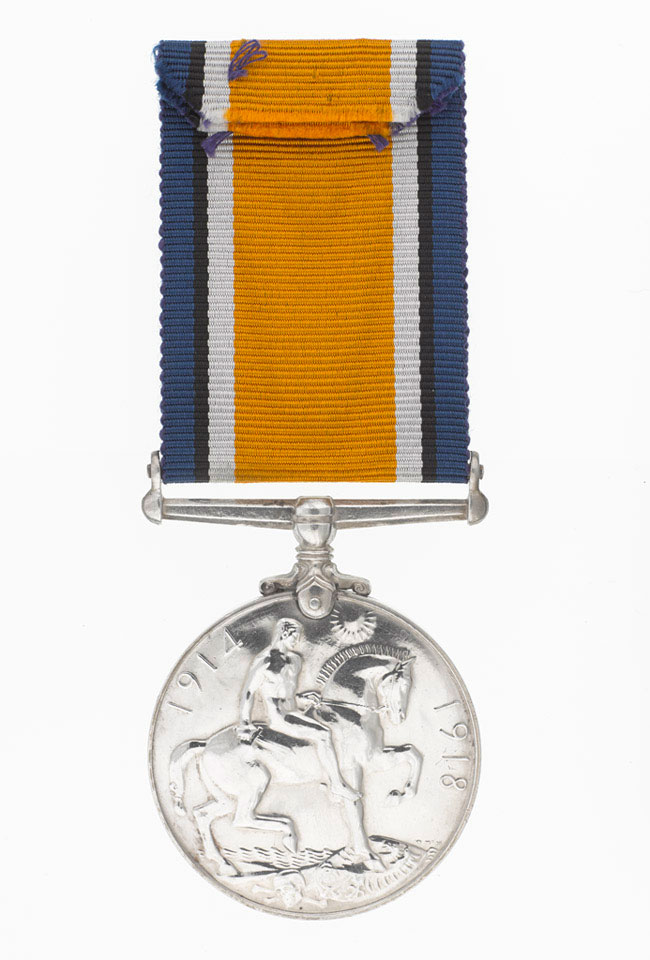
British War Medal 1914-20, awarded to Brigadier-General Reginald Edward Harry Dyer
Silver campaign medal with a portrait of King George V facing left with the inscription, 'Georgivs V Britt: Omn: Rex Et Ind Imp:', on the obverse and an equestrian figure of St George, trampling a shield bearing the Prussian eagle, on the reverse. Additional designs on the reverse include the years, '1914' and '1918', a skull and crossed bones representing death and a rising sun, representing victory. Orange corded silk ribbon edged with blue and white vertical stripes.
Dyer (1864-1927) was commissioned into the Queen's Royal Regiment (West Surrey) as a lieutenant before transferring to the Indian Army, initially joining the Bengal Staff Corps in 1887, but later transferring to the 29th Punjabis. He served with the latter in the Black Mountain Expedition (1888), the Relief of Chitral (1895) and the Mahsud blockade (1901-02). In 1901 the then Captain Dyer was appointed a Deputy Assistant Adjutant General. He was then transferred to the 25th Punjabis. In August 1903 Dyer was promoted to major, and served in the Zakha Khel Expedition (1908). He commanded the 25th Punjabis in India and Hong Kong and was promoted to Lieutenant-Colonel in 1910. During World War One (1914-18), he commanded the Seistan Force which prevented enemy infiltration from Persia into Afghanistan. For these services Dyer was Mentioned in Despatches and made a Companion of the Bath (CB). He was promoted colonel in 1915 and made a temporary brigadier-general in 1916.
Dyer was infamous for commanding the soldiers that opened fire on thousands of unarmed protesters at Amritsar in the Punjab on 13 April 1919. The protesters, as well as people out enjoying a local festival, were gathered at Jallianwala Bagh (garden) when they were fired upon without warning. Most of the people present did not know that Martial Law had been declared. The official report stated that 379 people were killed and 1200 wounded, but the true figure was much higher.
The British War Medal was awarded to all members of the British and Imperial military forces who completed 28 days mobilised service during 1914-1918. Although World War One ended in 1918, the qualification period for this medal was extended to cover post-war ordnance clearance and service in Russia during 1919-1920.
From a medal group awarded to Brigadier-General Reginald Edward Harry Dyer, Indian Army.
NAM Accession Number
NAM. 1990-12-54-5
Copyright/Ownership
National Army Museum Copyright
Location
National Army Museum, Study Collection
Object URL
https://collection.nam.ac.uk/detail.php?acc=1990-12-54-5