
Online Collection
« Prev - 1 of 1 results - Next »
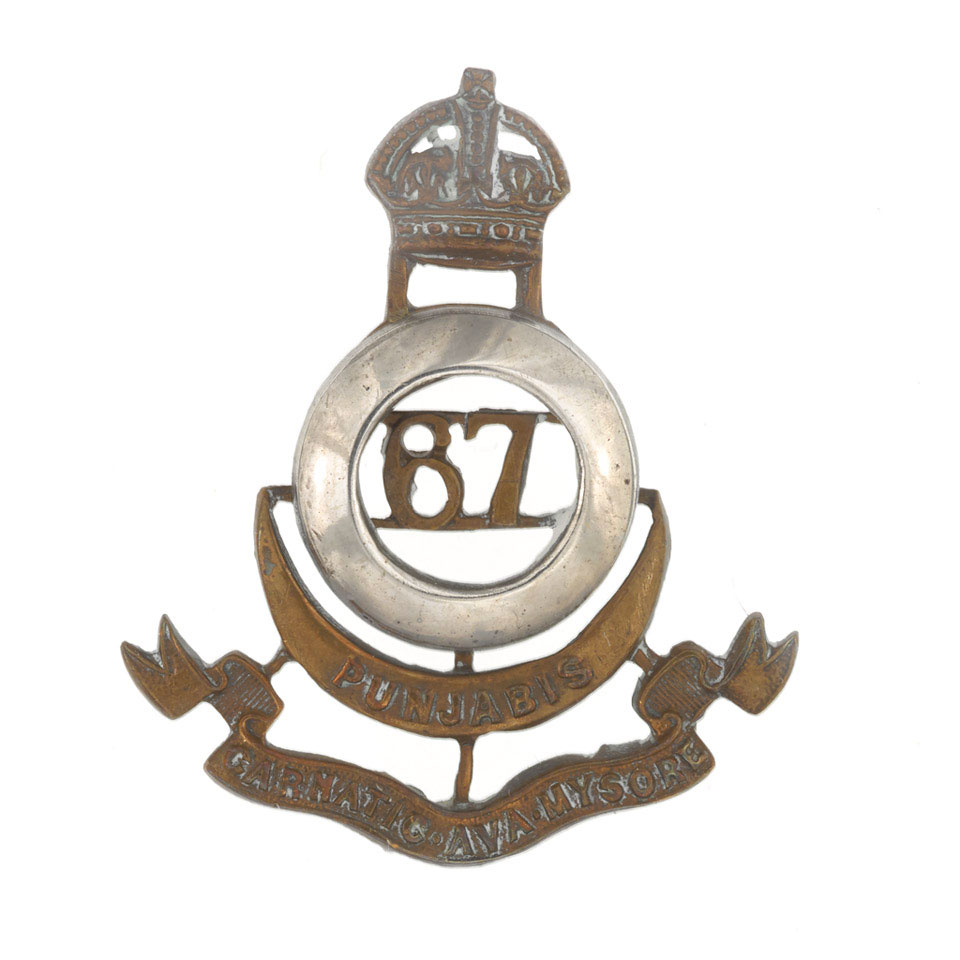
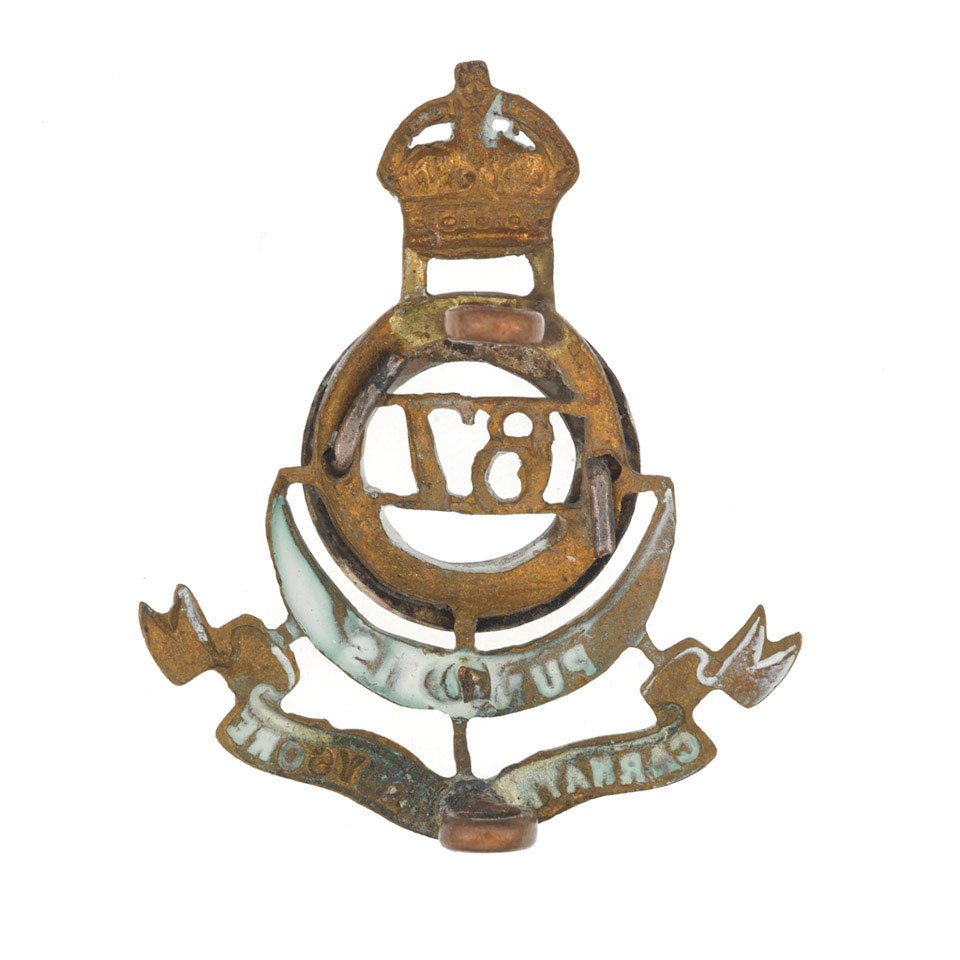
Cap badge, 67th Punjabis, 1903-1922
Bi-metal badge with an open work regimental number, '67', within a quoit, above a crescent bearing the title, 'Punjabis', surmounted by a King's Crown; with a scroll below bearing the battle honours 'Carnatic', 'Ava'' and 'Mysore'.
Quoits, or chakram, are a traditional edged weapon from the Indian subcontinent, particularly associated with Sikh fighters. They take the form of a flattened metal ring of varying circumference, with a sharpened outer edge, which can be thrown or used in hand-to-hand combat.
The 67th Punjabis was originally raised in Trichinopoly in 1759, as the 8th Battalion of Coast Sepoys. The unit was named the 7th Regiment of Madras Infantry in 1824. The term 'Native' was dropped from the regimental title in 1885. In 1903, during the reform of the Indian Army, the regiment was renamed the 67th Punjabis. During World War One (1914-1918), the regiment served in Mesopotamia. A second battalion was raised in 1915 and saw action on the North West Frontier of India during the war. It subsequently served in the 3rd Afghan War (1919).
In 1922 the 1st Battalion, 67th Punjabis became the 1st Battalion of a new 2nd Punjab Regiment. The 2nd Battalion, 67th Punjabis, formed a 10th (Training) Battalion. With the Partition of India, the regiment became part of the Indian Army.
The battle honours, 'Carnatic' and 'Mysore', refer to the regiment's service in the 3rd Mysore War (1790-1792), and 'Ava' refers to the 1st Burma War (1824-1826).
From the Field Marshal Chapple Indian Army Collection.
NAM Accession Number
NAM. 2013-10-20-28-21
Copyright/Ownership
National Army Museum Copyright
Location
National Army Museum, Study collection
Object URL
https://collection.nam.ac.uk/detail.php?acc=2013-10-20-28-21